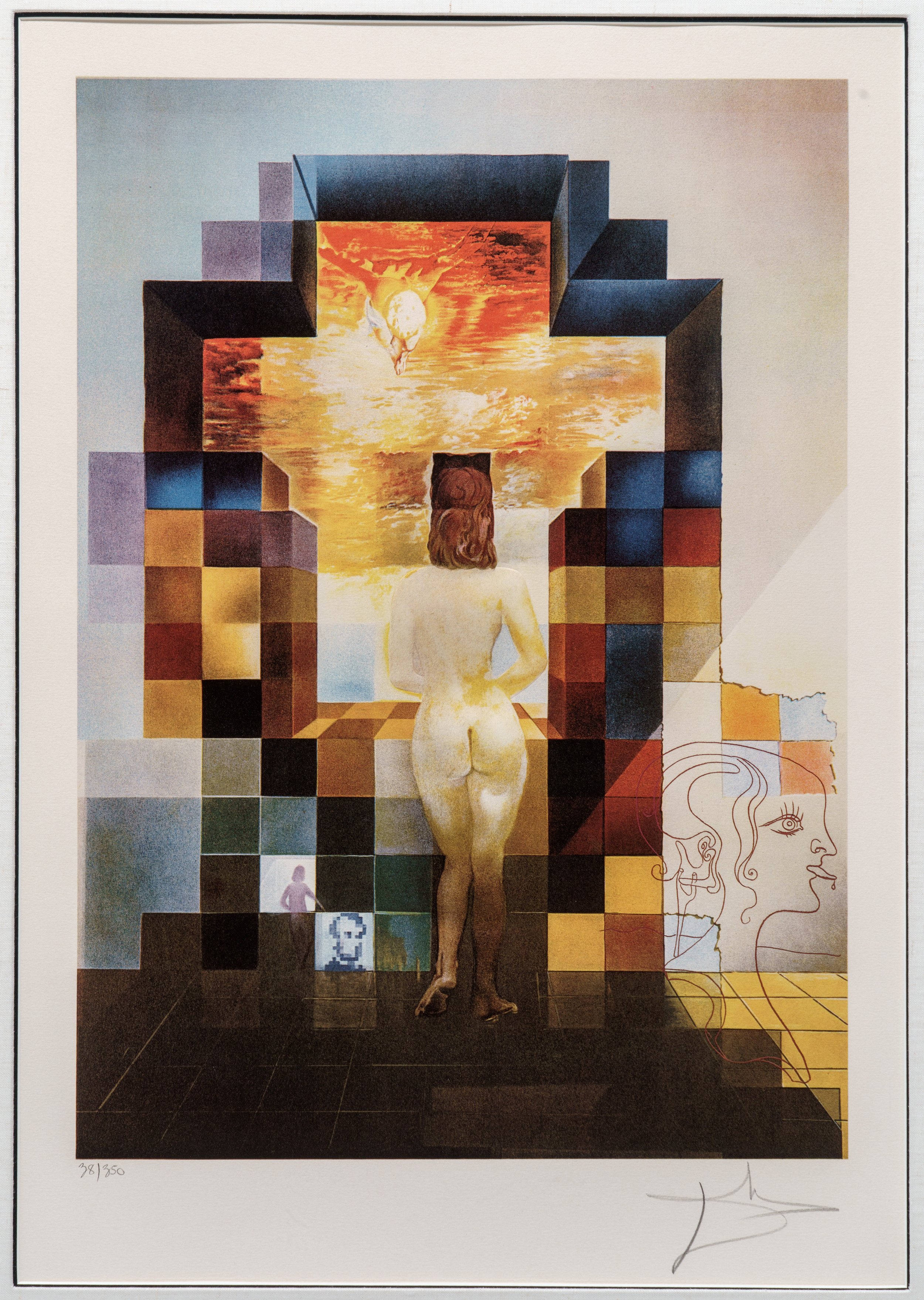

Salvador Dali (Spanish, 1904-1989)
Spanish artist Salvador Dali was born as the son of a prestigious notary in the small town of Figuera in Northern Spain. His talent as an artist showed at an early age. Dali's art teachers were a then well-known Spanish impressionist painter, Ramon Pichot and later an art professor at the Municipal Drawing School. In 1923 Dali's father bought his son his first printing press. He began to study art at the Royal Academy of Art in Madrid where he was expelled twice and never took the final examinations. He was influenced by Cubism, Futurism, and other movements and is best known for his Surrealist painting. He had a knack for self-promotion and thrived on eccentricity and exhibitionism.
As an artist, Salvador Dalí was not limited to a particular style or media. The body of Dali's work, from early impressionist paintings through his Surrealist works of the 1930s, and into Dali's classical period, reveals a constantly growing and evolving artist. Dalí worked in all media, including film-making and writing, and left behind a wealth of oils, watercolors, drawings, graphics, and sculptures, jewels and objects of all descriptions. His masterworks are in major museums such as The Persistence of Memory, 1931, which is in the collection of the Museum of Modern Art, New York and features a melting watch – an image that became one of the iconic and parodied in all of 20th century art. He also has a large body of work of which the subject is his wife, Gala. There is a museum devoted to his work in Figueras, Spain (his home-town) and another in St. Petersburg, Florida.